|
Analysis Mechanically, there are three balance factors associated with holding the flute:
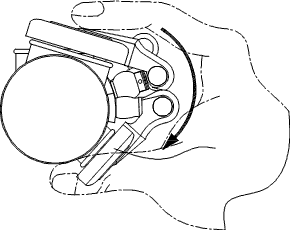
The gravity center of a flute is located slightly to the right of the left index finger (see letter G in Illustration 1 below). When the first knuckle of the left index finger takes up most of the weight of a flute at number 2, a small remaining weight will need to be assumed by the right thumb. When playing a flute, the embouchure plate is being push against the chin (Ill. 1, number 1). Together with the left index finger supporting and pushing, the flute would rotate clockwise if there does not exit a counter force from the right hand. Additionally, the uneven weight of the flute mechanism contributes to another rolling tendency. This can be seen in Ill. 2. To a player, the flute rolls towards him or her (backwards).
Illustration 1
Illustration 2
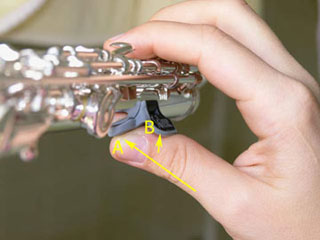
Because nine of our fingers are used to operate keys on a flute, only one, the right thumb, is left to decisively balance it. Many flutists knowingly or unknowingly use their right little finger to help. It reduces the agility of not only the little finger but also the rest of the right hand. Thumbport Solution The Thumbport snaps onto to the flute at around the F key. It guides one's right thumb to support the flute at an angle (force A in Ill. 3). This force can be seen as the sum of two separate branches: one supports the flute from below and the other counters the horizontal rotation. The extension arm rests on the thumb gently (B in Ill. 3), which easily prevents the flute from rolling backwards. Illustration 3
There are other possibilities in using the Thumbport. Please take a look at the Mods page. |
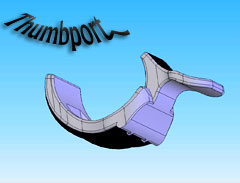 The Thumbport aids the balance in holding the flute, which
is comprised of a C-shaped
shell and an extension from one
end of the openings. This thumb-like extension is
toward the flute player when the C-shell is clamped onto the flute.
The Thumbport guides the player's right thumb at an efficient
location and provides additional
support.
The Thumbport aids the balance in holding the flute, which
is comprised of a C-shaped
shell and an extension from one
end of the openings. This thumb-like extension is
toward the flute player when the C-shell is clamped onto the flute.
The Thumbport guides the player's right thumb at an efficient
location and provides additional
support.